Friday, 31 July 2015

BOOK REVIEW


 THE FOUNTAINHEAD –AYN RAND


Fantasy as a world is amazing, reality is boring.
The book does the work of immaculately bridging the gap between both these worlds. The book takes you away from the much perceived reality to the thrill of fantasy, but not quite actually leaving you there. You end up lingering between the two, just as the story mocks you while portraying the harsh truth that, ‘this is reality, but not the way you know it!’
     Howard Roark, the lead protagonist is an architect; Dominique Francon is his love interest. Ambitious, determined, cold, you name it and the man has got everything that takes to become successful. But the one virtue which ends up becoming the reason for his downfall- his integrity.
    The story starts off with events giving us a glimpse on the working style of Howard Roark, which is quite contrary to the conventional style of architecture. The story progresses with the introduction of other characters. What I liked about the story was that each character has been given his/her own space to justify themselves. Like any other story, this one has its own heroes as well as villains. But as you go about knowing more and more of each character, you end up realizing that injustice has been done upon every character at some point, which is why they are right in doing what they do.
     There are many unusual things happening at one time in the story like- Dominique belittling Roark’s work, and creating a negative opinion about him in her articles despite her undying love for him; Roark’s helping Peter Keating in spite of the rivalry between the two, and so on. One can’t help but wonder why and ask questions to oneself. The interesting part is that the answers to all these questions aren’t given at the end, they are revealed at the start itself, in the explanation of the character sketches of each character.
        Ayn Rand is a fabulous writer. She has managed to capture the politics and working of the media world in the book, which are relatable to people from every age and time. Also, the portrayal of characters by her in relation with the time frame of the story is perfect. Actually to be very honest, there is no time frame for the story. It is written carefully in such a manner that readers from any age and time will relate with it. Considering that fact, it is quite difficult to believe that the book was published in 1943!
        You need to read the book because-
A-    It helps you to know more about what goes on in people’s minds.
B-    It talks about the media world in context with philosophy.
C-    As a book, it is unputdownable.
           As the story unfolds itself, the shocks, disappointments and twists make you wonder if there is any conclusive, happy ending to the story. But you get so involved in the intricacies of the tale, that you forget about the happy ending and demand more of the story! Well, I won’t be a spoilsport to give off the climax or the ending in the review, for that you will need to read the book!
   
        I would give this philosophically thrilling tale 5 star.
The characters I relate with- Howard Roark and Peter Keating combined.  

 P.S- The book was also created as a movie. 

Saturday, 27 June 2015

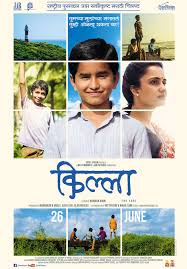
Killa- Movie Review

       Overall plot-
Chinmay has to shift from Pune to a village in Konkan because of his mother’s transfer. Change of place and area can take its toll on anyone’s life- be it a 12 year old or a grown up. This story is about how Chinmay and his mother cope up with the life of village Konkan, its people and the respective surroundings.
                                 
                                       Killa- Movie Review


    Avinash Arun (the director) got the idea for this movie when he was studying at FTII. His father had to be transferred from his job from place to place which displeased Avinash. In a way we can say that Chinmay (Archit Deodhar) in the movie portrays the real life Avinash. Screenplay writers Tushaar Paranjype and Upendra Sandhaye have done a great job in putting it on paper. That could explain why the movie managed to capture all the nuances and subtleties of the topic at hand, as gracefully as it can.
     The major topic in question is- are you able to guess what goes on in your child’s mind?
The film subtly answers this question without any tinge of melodrama which could primarily be the reason why the movie bagged praises, and awards.
      Chinmay (Archit Deodhar) is portrayed both talented and artistic in the movie, fondly named as ‘Shishyavrutti’ (scholarship) by his friends. From playing the wise but quiet kid, to portraying the angry and demanding one, he carried it off easily in one movie sequence itself. Owing to this reason I can safely say that Archit was completely in Chinmay’s skin while playing the role. Although the movie appears to be slow and tacit but Bandya and Chinmay’s other friends manage to pull off the humour quotient of the movie appreciatingly. Talking about the entertaining part, I can’t help but give a standing ovation for Bandya’s (Parth Bhalerao) performance in the film. You can say it merely by observing him that it’s not just his dialogues which are doing the trick. Bandya by himself has the capability to tickle the funny bone.
      I found the direction of the movie expecially appealing. From getting the children to do their part, to bringing out the best in them and giving a justice to the screenplay at the same time, Director Avinash Arun has done a fabulous job. The film doesn’t simply tell you a story; it gets you enagaged with itself in the ‘KILLA’ and gives you the feel of-
- Sound of the waves carrying its message.
 -A view from the top of the killa signifying the heights to which the movie has reached.
-The gentle feel of air of the movie, reaching out to your soul.
      Apart from the direction and screenplay, another element worthy of a credit is its editing. Editor Charu Shri Roy, conspicuously made sure that he gives his personal best for this masterpiece. He knows direction, he knows writing, and maybe it is this knowledge that made him ‘trim’ the movie just right. In that way,I would be lying if I say that only the director deserves a credit; editors, screenplay writers, cinematographers, etc everyone is worthy of a praise for creating this masterpiece.

    Overall I would give this movie 4.5 star.

Epilogue-

Awards bagged by the Movie (Berlin Film Festival)-
 Crystal Bear- best film generation  Kplus section.
 Special mention- generation Kplus section.


 Role I would have liked to play- Bandya.

                                                       Thankyou :)


Sunday, 21 June 2015

Goshta Tashi Gamtichi- Drama Review


          In spite of the progression of cinema, theater hasn't lost its charm yet. Actors performing live for a host of audiences sounds more enchanting than watching a movie on a 70mm screen. According to me, it takes actual talent of acting to express yourself in front a large audience. Marathi dramas for that matter, never fail to entertain me. I will be writing reviews of dramas over here, in my blog. 

                  Goshta Tashi Gamtichi (A story of fun.)


  The plot revolves around a maharashtrian family which skillfully portrays the nuances of the life of any regular middle class family.
    Kunal, (Shashank Ketkar) plays a role of the son of a middle class teacher Mr. Sanjay Dikshit (Mangesh Kadam) and Mrs. Vaasanti Dikshit (Leena Bhagwat). After his graduation, Kunal takes the decision of becoming an entrepreneur. The thought of his only son wanting to do business instead of a stable government job, is highly shocking to the closed mindset of Mr. Dikshit. To top it, Kunal a rebellious son, is shown at loggerheads all the time with his father. Quarrels between them with no apparent conclusion are shown frequently. Both the son and father standing by their own ground, are reluctant on accepting each other’s views. When a middle class closed mindset battles with its adversary- a turbulent broad mindset, the resulting consequences given their respective natures are quite predictable. But the flow of events and the plot tend to be quite gripping. 
Mrs. Vaasanti Dikshit is an interesting character too. Indifferent to the dispute sessions between her son and her husband, Vaasanti is showcased as the occasional mediator between their arguments. In spite of having almost no contribution in their quarrels, she even makes her silent presence felt onstage by the occasional inputs like- closing the windows during their argument, laughing once in a while at either of their dialogues, etc.       
 One of the many debates between Kunal and his father, lead them into playing a game of listening to one command of each other per day. In the first round itself, Sanjay Dikshit fails to obey a simple command which required him to say “I love you, beta” to his son and instead ends up saying “I hate you”, rather gravely. The game progresses with similar commands. One among them required Sanjay to take his wife on a date. Sanjay Dikshit, who never crossed the protective boundaries of “Parla (E)” as they mention it, takes his wife to Juhu beach for a “date” where they rediscover their love for each other whilst their merry making. One can’t help but smile while observing their chemistry which is quite resembling to any middle class couple. 

“You are never too old to express your love towards loved ones. Confessing the same once in a while actually strengthens the bond.”

     In another command, Sanjay out of nowhere asks Kunal to leave the house for 3 days. That, I would like to call as the defining moment of the play because it is only after it, that the actual topic (Generation gap) starts to materialize. He does oblige to his father’s command. Kunal returns after three days, with the understanding for his father’s viewpoints, thinking and life. Just like Kunal learns to accept his father’s viewpoints, so does his father learns to accept his son’s decisions giving a conclusive end to the ‘gamtichi goshta.’
     
   The plot effectively not only covers the problem at hand, but also provides solution to tackle the same.However the sudden light of wisdom in Kunal’s thinking after he leaves home is something that appears like a utopia. But that can be accepted, considering rest of the plot. After all, anything that takes us away from reality sounds entertaining!
Barring that, the drama is very much novel in its reach, and it is something which every family could relate with. In spite of being a common topic, the writer Mihir Rajda has done a fabulous job in making it look novel and different. Equal credit must be given to the director Advait Dadarkar too, for maintaining the entertainment and seriousness quotient at the same time. 
 It has its own quirky, funny, relatable elements which makes it a complete entertainment package
Overall, I would give the drama 3.5/5 stars.


Saturday, 23 May 2015

Its the bitter tonic that you drink, but its the knowledge which sinks in.


     History is replete with the examples of kingdoms and lords who learned their lessons by experiencing those themselves. Importance of an impregnable door for a fort wasn't realized until the enemy easily won the battle by entering through the entrance. Importance of decentralization of power in politics wasn't realized until a kingdom failed under the hands of an incompetent king. The kingdoms neither learned through education nor through tales of neighboring kingdoms. They learned solely through experience.

  For getting rid of a disease, one needs to gulp a spoonful of a bitter tonic. It is this bitter tonic that gives them the knowledge of living a healthy life, to avoid the disease.  

   To talk about present times, there are many events which provide examples for the topic in concern. Take for example the case of Aruna Shanbaug- the center of attention in a court case on euthanasia; after spending 42 years in a coma as a result of a sexual assault. It was only after her plight, that the legislation for passive euthanasia gained momentum. Legislation for a new act, whereby a person can state in one's will that if he ever happens to enter a vegetative state (coma) and that no medications works on him whatsoever, he is to be ridden of the ventilator after the specified period of time. Both the legislations if passed will be instrumental in trapping the criminals booked under euthanasia and freeing   the victims of coma. 

   It took the martyrdom of 3 senior fire-brigade officials for the government to realize that safety measures, medical insurances, pensions, etc are a dire need for the fire-brigades who risk their lives.
It took one Zeeshan Khan's bold stand against the corporate officials (who rejected his application because he was a Muslim) to bring to the fore the discrimination faced by the disadvantaged communities.

     As you might notice, the arguments mentioned in the above cases like the right to die, right to safety, and the rights to oppose discrimination aren’t new. They have been argued upon since many years. People's tragedy, experience and voice, was all it took for them to be finally acted upon.

      Talking about that in a national context, surely, India is facing many problems. But they are those problems which will build up India into an experienced one. An experienced India, prone to achieving growth and development. 
                                    
                                          Thank You.


Thursday, 21 May 2015

The struggle, his story.


PROLOGUE-
Narayan Wani, was a self-made successful entrepreneur of Kalyan, Mumbai. Even in the face of many ups and downs, he managed to build the life of his dreams for himself, and his family. He was my grandfather. This, is his story. 

The struggle, his story.

“Let’s start a business of our own,” said Nana
      “Don’t you think we are too young for that?” asked Motiram
“We don’t have any other option, you know that.”
                                                   “All right. Let’s do it." 
Exactly 8 years before this incident, two brothers- Narayan, who was fondly called as Nana and Motiram had arrived at Kalyan, leaving their village Gudhe. They had come here with the purpose of assisting their wealthy maternal uncle.
Nana was 9, when he started working under his uncle along with his brother. They used to take care of his grocery shop, assist the uncle in business dealings. The uncle, used to make both the brothers toil day in and day out, without giving any paycheck. Only one square meal was provided to the brothers. But Nana and Motiram still worked without complaining over there. Nana completed his education till 7th grade at Kalyan.  After a few years, they moved out of their uncle’s business to search a job, with a paycheck. They were soon offered a job at a mess, under Mr. Damle. Nana and Motiram received a paycheck of Rs. 60 and Rs. 75 respectively.

 Nana liked observing the business dealings, interacting with the customers at his uncle’s place and at the mess too. Giving in to this knack for business, Nana thought of setting up a shop of his own. He got a positive reply from Motiram. After saving a sufficient sum from their paychecks, they finally bought a shop. Nana was 17, at that time.
In the year 1946, they bought a place and finally set up a shop of their own. They named it as, “Motiram and brothers.” Groceries like oil, sugar, food grains, spices,etc everything was made available at that shop. They enjoyed a good business, and were able to financially stabilize themselves. They even bought a house of their own. After doing that they brought their parents and 2 brothers to Kalyan. When they reached maturity, both the brothers got married and had their own families. Nana soon became a proud father of 4 kids. A few years later, Motiram shifted with his family of a wife and 5 kids to another city, Dombivli. After Motiram left, Nana was all on his own now. Right from the buying of groceries at a good bargain in the market to selling those in his own shop, Nana used to deal with everything. With his polite speech and good nature, Nana used to win the trust of every customer. His basic qualities like these, gradually paved way for immaculate business dealings and efficient client-servicing. Eventually, Motiram and brothers became the most popular shop in that area. He later bought two new shops, and even constructed a building for his family.
Nana didn’t restrict the purchase of groceries to the local market; he started exploring the territories in Mumbai too. He lived a rich lifestyle. He was a health and fitness freak, even in those days. With his fighting spirit and never-say-die attitude he conquered great heights.
 Nana passed away on 4th may, 1991. He not only left a business to his sons, but also valuable life lessons, ensuring that his legacy continues even after he dies.
THE END.